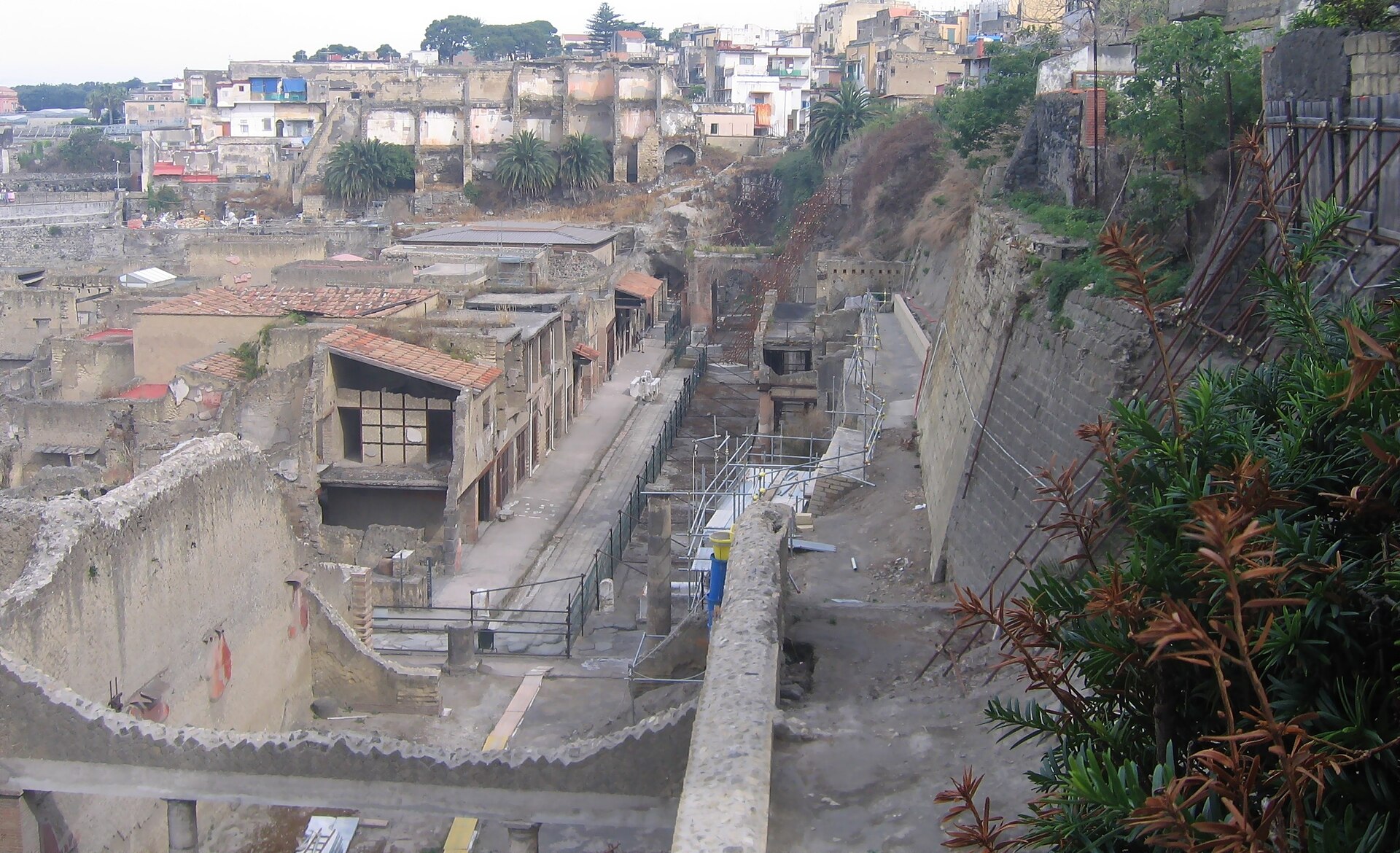
Herculaneum occupied a promontory on the Bay of Naples about 8 km from Vesuvius. Its 4,000–5,000 residents were comparatively prosperous: large seafront villas, a theatre seating 2,500, well-appointed public baths, and the Villa of the Papyri, whose library held over 1,800 Greek philosophical scrolls. The sea provided fish; volcanic soil supported orchards and vineyards.
In the early hours of 25 August 79 CE a pyroclastic surge of roughly 400°C reached the town at speed, killing anyone who remained almost instantly. Successive flows buried it under 15–18 metres of material that set like concrete, preserving it far more completely than Pompeii. Excavation has been intermittent since the 1730s because modern Ercolano sits directly above. The site is a UNESCO World Heritage Site jointly listed with Pompeii.
Worth remembering
- Herculaneum was a quiet coastal resort favoured by wealthy Romans, with large seafront villas, a theatre, a forum, bath complexes, and the Villa of the Papyri whose library held over 1,800 carbonised scrolls.
- Its extreme preservation means wooden beds, carbonised loaves, fishing nets and wax writing tablets survive, making it one of the richest single snapshots of Roman daily life ever excavated.
The people
-
Pliny the Elder — Roman admiral and naturalist who died trying to rescue survivors, 23–79 CE
Commander of the fleet at Misenum, he sailed toward the eruption to investigate and aid refugees and died on the shore, as recorded by his nephew.
Gallery
Watch
Further reading
Sources
- Herculaneum had 4,000–5,000 inhabitants; a pyroclastic surge of about 400°C swept the city at high speed, killing residents almost instantly. Encyclopaedia Britannica
- Unlike Pompeii, Herculaneum was buried under flows that hardened to rock, preserving organic materials including wood, cloth, food and papyri. World History Encyclopedia
- Excavation yielded the Villa of the Papyri with over 1,800 carbonised scrolls, the largest surviving library from antiquity. National Geographic
A graveyard tradition: leave a stone to show you came, and remembered.