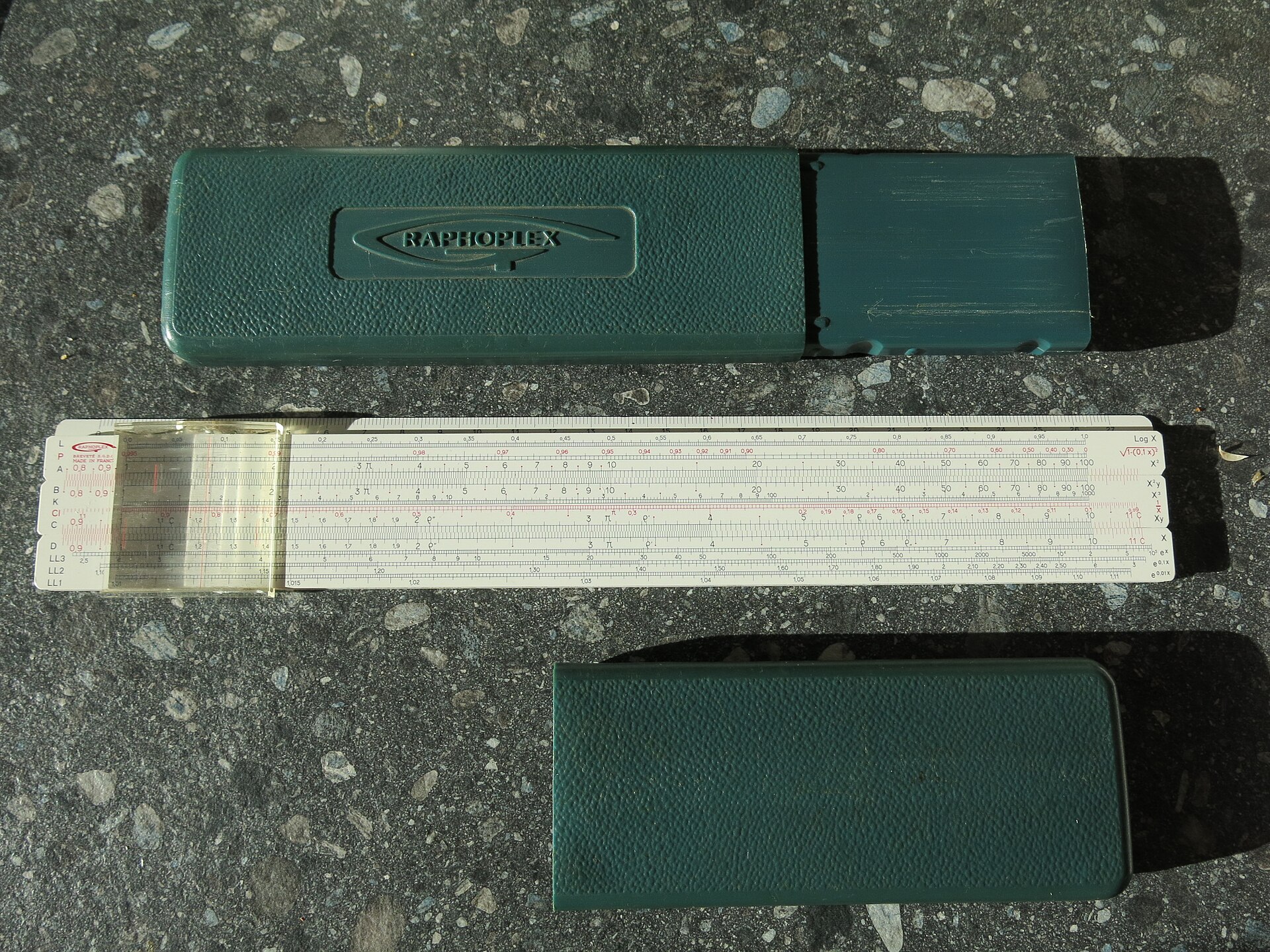
For three and a half centuries, if you wanted to multiply, divide, or find a square root quickly, you reached for a slide rule. Built on Napier’s logarithms and first assembled by William Oughtred around 1622, it was the constant companion of every engineer, navigator, and scientist — the analog computer that designed bridges, skyscrapers, aircraft, and the rockets of the Apollo program. Astronauts literally carried them to the Moon.
Its end was sudden and total. In 1972 Hewlett-Packard released the HP-35, a pocket electronic calculator, and within two or three years cheap calculators had made the slide rule obsolete almost overnight. Keuffel & Esser, the great American maker, produced its very last slide rule on 11 July 1976 and donated it to the Smithsonian. A tool that had served for 350 years was rendered silent in less than a decade — the cleanest case of obsolescence in this whole wing.
Worth remembering
- Slide rules took astronauts to the Moon: Apollo crews carried Pickett models, and Buzz Aldrin's flown slide rule later sold at auction for $77,675.
- Keuffel & Esser made roughly 3.5 million wooden slide rules over 55 years before closing the line in 1976.
The people
-
John Napier — Invented logarithms, 1550–1617
His logarithms (1614) turned multiplication into addition — the mathematics the slide rule is built on.
-
William Oughtred — Inventor of the slide rule, 1574–1660
An English clergyman-mathematician who slid two of Gunter's scales together; he also gave us the '×' sign.
Gallery
Further reading
Sources
- Slide rule invented c. 1622 by Oughtred; killed by the pocket calculator in the early 1970s Wikipedia
- Keuffel & Esser produced its last slide rule on 11 July 1976 and gave it to the Smithsonian EDN
- Apollo 13 astronauts carried a 5-inch Pickett N600-ES slide rule for calculations during their April 1970 mission; the original is preserved at the Smithsonian National Air and Space Museum
- The HP-35, released in January 1972 at $395, was the first pocket calculator to replicate all slide rule functions and sold over 100,000 units in its first year Computer History Museum
A graveyard tradition: leave a stone to show you came, and remembered.