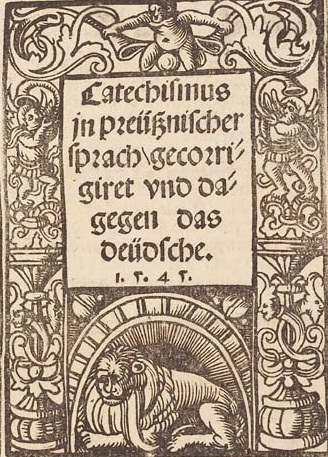
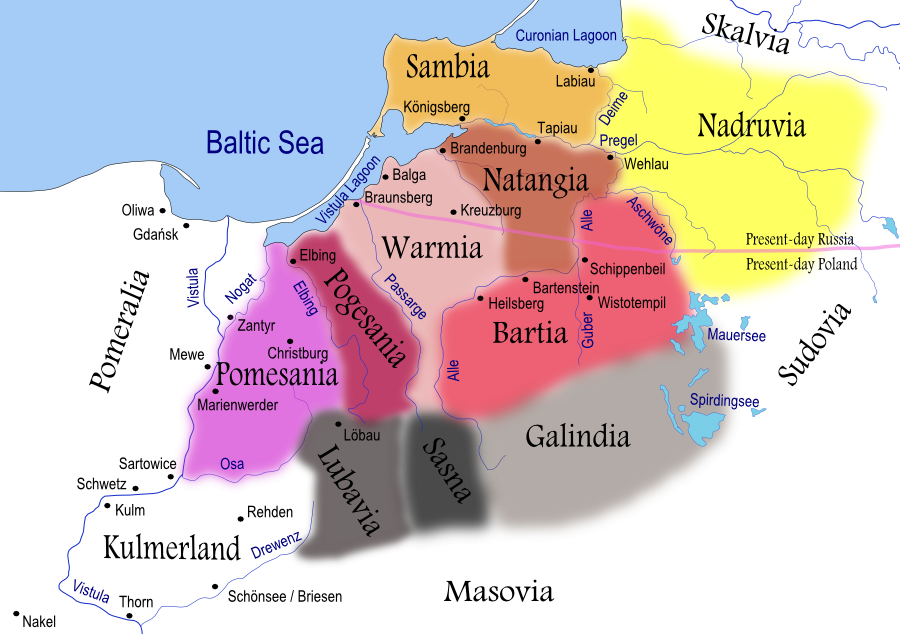
Old Prussian was the language of the Baltic-pagan tribes along the south-eastern shore of the Baltic Sea, and the only West Baltic language to survive in writing. In the thirteenth century the Teutonic Knights conquered Prussia, and over the next four hundred years its speakers became a peasant underclass beneath German, Polish and Lithuanian settlers.
Its whole record is a vocabulary of some eight hundred words compiled around 1300 and three catechisms printed in Königsberg between 1545 and 1561 — books made to carry Lutheran doctrine to people who no longer understood German, and which became, by accident, the language’s tomb. No text survives after 1561, and the East Prussian plague and famine of 1709–11 are thought to have killed the last who still spoke it. A handful of activist families have since raised children in a reconstructed “New Prussian,” rebuilt from those same surviving pages.
Worth remembering
- The three catechisms were printed precisely because the people no longer understood German sermons — Lutheran doctrine in the speakers' own tongue, made to convert a population away from its old Baltic-pagan world.
- It preserved archaic Indo-European features lost in its surviving Baltic cousins Latvian and Lithuanian, including a neuter gender — a window onto a much older stage of the family.
Gallery
Sources
- The Teutonic Knights conquered Old Prussian territory in the 13th century, and over the following 400 years its speakers were reduced to a peasant underclass among German, Polish and Lithuanian settlers. Wikipedia
- The entire surviving corpus is the Elbing vocabulary of about 800 words (c. 1300) and three catechisms printed in Königsberg between 1545 and 1561 — the last known written records of the language. Britannica
- Old Prussian is the only West Baltic language with surviving written records; its closest relatives, Curonian and Galindian, left no texts at all. Wikipedia
- The Elbing vocabulary, compiled around 1300, is the earliest surviving Old Prussian text — a German–Prussian word list that predates the three catechisms printed in the 16th century. Encyclopaedia Britannica
A graveyard tradition: leave a stone to show you came, and remembered.