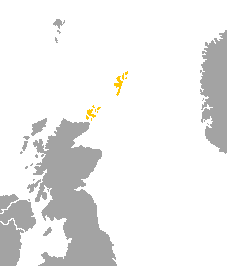
Norn was the North Germanic speech of Orkney, Shetland, and Caithness, carried there by Norwegian settlers around the ninth century and spoken on the islands long after the Viking age had passed. When the Danish-Norwegian crown pledged the islands to Scotland in 1468–69, Scots began a slow advance, and over the following centuries Norn retreated from the towns to the crofts and from the young to the old.
By the eighteenth century it survived mainly in the far north. Walter Sutherland of Skaw, on the island of Unst, is remembered as its last fluent speaker, dying around 1850; scattered words and rhymes lingered on remote Foula into the early twentieth century. Its longest surviving text is the Hildina ballad — thirty-five stanzas of a Norse heroic tale taken down on Foula in 1774 by George Low from an old man who had memorised it as a child and could no longer say what the words meant.
Worth remembering
- Its speakers kept an oral poetry continuous with Old Norse: the Hildina ballad, a Norse heroic tale of an Orkney earl and a Norwegian king's daughter, survived only because one old man on remote Foula had memorised it in childhood.
- Norn left its fingerprints all over living Scottish speech — place names, fishing words and weather terms in the Shetland and Orkney dialects are its quiet inheritance.
Gallery
Sources
- Norn descended from the Old Norse brought to Orkney and Shetland by Norwegian settlers from around the 9th century; after the islands were pledged to Scotland in 1468–69 it was gradually displaced by Scots. Wikipedia
- Walter Sutherland of Skaw, on Unst, is cited as the last native speaker and died around 1850, though fragments survived later on Foula. Wikipedia
- The largest surviving Norn text is the 35-stanza Hildina ballad, recorded phonetically on Foula in 1774 by George Low from an old man who had memorised it as a child but could no longer translate it. Wikipedia
- Norn was a North Germanic language spoken in Shetland, Orkney, and Caithness until the 19th century; the last native speaker, Walter Sutherland of Skaw in Unst, died in 1850, though fragments survived on remote islands into the 1890s. Omniglot
A graveyard tradition: leave a stone to show you came, and remembered.