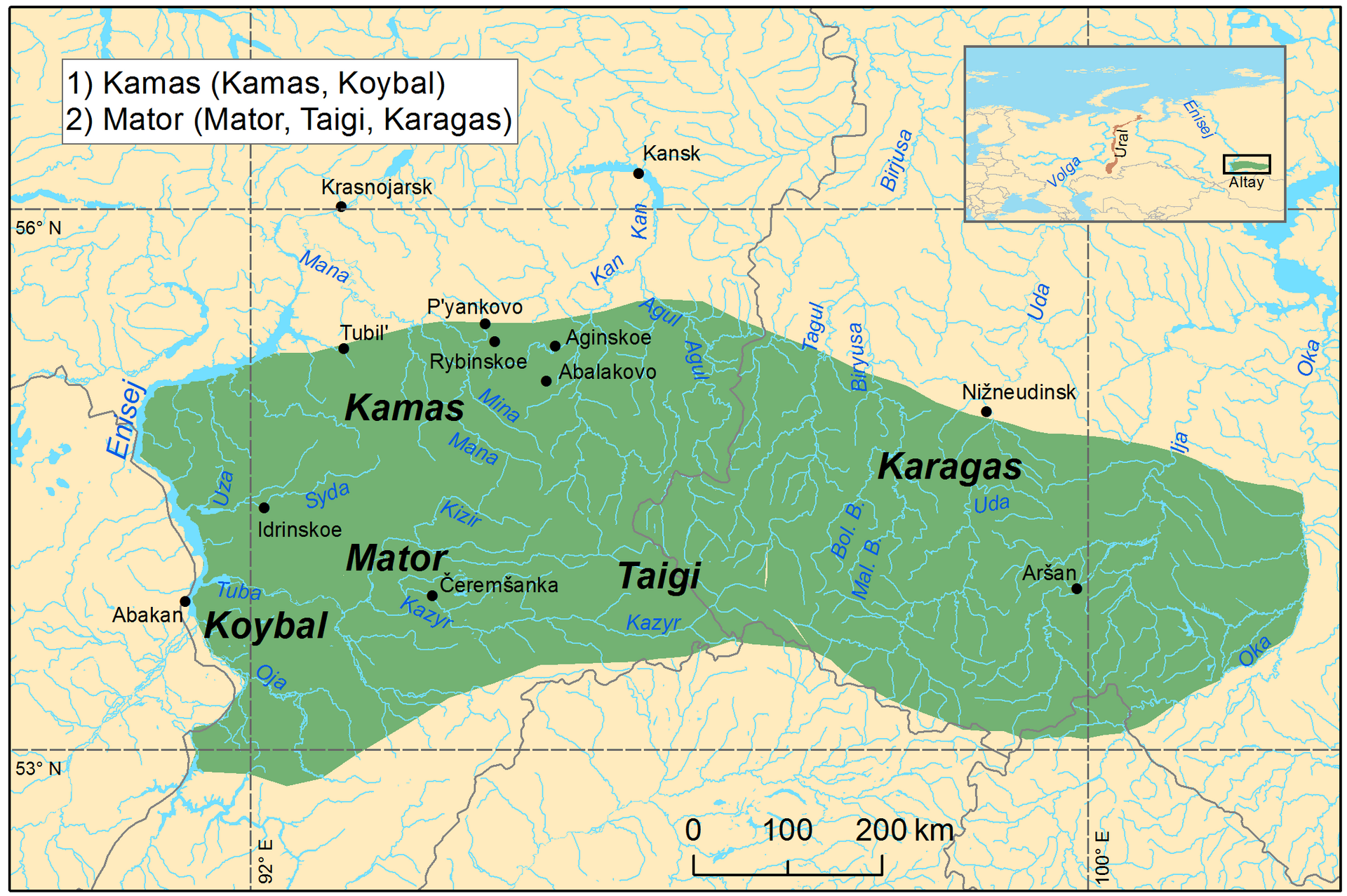
Kamassian was a Samoyedic language of the Uralic family, recorded in two dialects — Kamassian proper and Koibal — and spoken by small bands of reindeer-herders and hunters in the Sayan Mountains of southern Siberia, the southernmost reach of a family otherwise belonging to the far Arctic north. Pressed by Russian and Turkic neighbours, the Kamasin people assimilated across the eighteenth to twentieth centuries, and the language stopped passing to children.
Linguists had recorded it as it declined — the Finn Kai Donner in the 1910s, when the speakers were already elderly — and by mid-century it was presumed extinct. Then Klavdiya Plotnikova was found in the village of Abalakovo, still able to speak it; most of what is known of Kamassian comes from her. When she died on 20 September 1989, the language died with her, leaving a record of roughly fifteen hundred words.
Worth remembering
- Sitting where the Uralic, Turkic and Yeniseian worlds met, Kamassian gathered loanwords from all sides while keeping a Uralic skeleton — a small tongue at a crossroads of three language families.
- When Kai Donner recorded it in the 1910s the speakers were already old and the language no longer passed to children; his notebooks captured a tongue already in its final years.
Gallery
Sources
- Kamassian was a Samoyedic language of the Uralic family spoken by the Kamasin people north of the Sayan Mountains in Siberia — the southernmost attested Samoyedic language. Wikipedia
- The language was presumed extinct until the last speaker, Klavdiya Plotnikova, was located in the village of Abalakovo; she provided much of the surviving documentation and died on 20 September 1989. Wikipedia
- Finnish linguist Kai Donner carried out the first systematic documentation of Kamassian in the 1910s; the surviving record totals roughly 1,550 words. Wikipedia
- Kamassian had two recognized dialects — Kamassian proper and Koibal — and was spoken between the Uralic Mountains and the Yenisei River before its extinction with the death of the last speaker in 1989. University of Vienna (NOS Project)
A graveyard tradition: leave a stone to show you came, and remembered.