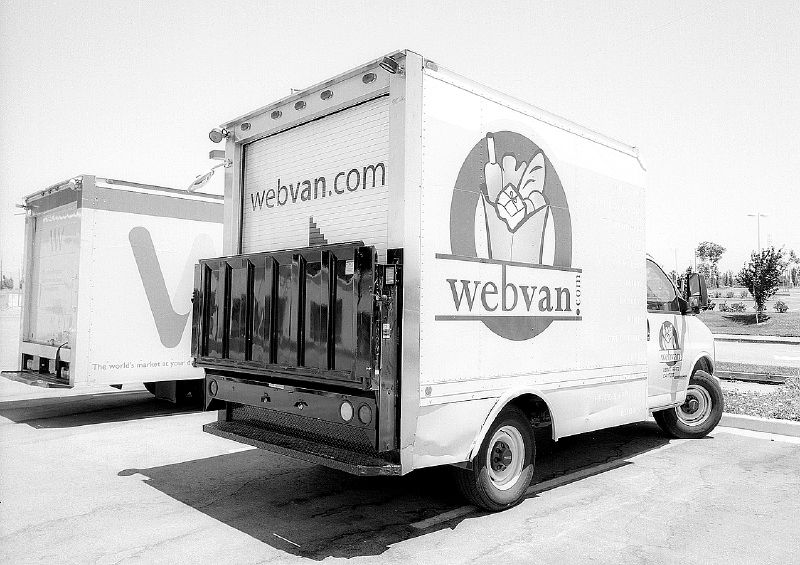
Louis Borders had already co-founded a large bookstore chain when he started Webvan in 1996 with a genuinely ambitious idea: grocery delivery in a 30-minute window, served by custom-built automated warehouses. Backed by Goldman Sachs, Benchmark and SoftBank, it raised over $1.2 billion and went public in November 1999 at a valuation near $4.8 billion — before it had proved the model in even one city.
Under pressure to grow, management expanded to about ten markets at once, spent some $525 million against $178 million of revenue in 2000, and chased the price-sensitive mass market rather than affluent customers who would pay for delivery. Each warehouse cost tens of millions; each order lost money. The unit economics never worked. Webvan filed for bankruptcy in July 2001, three years after starting, and laid off 2,000 people. Amazon launched its own grocery delivery six years later, having learned from exactly these mistakes.
Worth remembering
- Webvan promised grocery delivery within any 30-minute window the customer chose, a guarantee that required custom automated warehouses costing tens of millions each, in cities where it had no profitable customer base yet.
- CEO George Shaheen left the top job at Andersen Consulting, overseeing tens of thousands of staff, to run Webvan in 1999 on a contract that promised him $375,000 a year for life — payments that continued after the company collapsed.
Gallery


Sources
- Webvan was founded in 1996 by Louis Borders; its November 1999 IPO valued it near $4.8 billion, and it raised hundreds of millions in venture capital on top of the IPO proceeds. Wikipedia
- At its peak in 2000 Webvan generated about $178 million in revenue against roughly $525 million in spending; it lost over $800 million before filing for bankruptcy in 2001 and laying off 2,000 staff. Wikipedia
- Webvan is a standard case study in dot-com failure: expanding to many cities before proving the model, chasing price-sensitive customers, and building capital-intensive proprietary warehouses instead of using existing supermarkets. Encyclopaedia Britannica
A graveyard tradition: leave a stone to show you came, and remembered.